
Travel guide
Dubai Guide for Georgian Travelers: Visa, Flights, Budget and Everything That Matters (2026)
Disclosure: when you book through some of our links, your booking earns the site a small commission, at no extra cost to you.
For a Georgian traveler, Dubai is an unusually easy destination: visa-free, a direct four-and-a-half-hour flight from Tbilisi, warm in winter when Tbilisi is grey and wet, and varied enough that a single trip can hold desert, skyscrapers, old souks and a beach. This guide is written for someone flying from Georgia — with verified facts, real ranges, and honest advice.
Visa & entry rules (as of July 2026)
Georgians don't need a visa for Dubai. Georgia and the United Arab Emirates (UAE) have a mutual visa-waiver agreement: a Georgian holding an ordinary (biometric) passport can enter and stay in the UAE for up to 90 days without a visa. Source: Embassy of Georgia to the UAE (as of July 2026).
What to sort out in advance:
- Your passport must be valid for at least 6 months from your date of entry.
- Carry a return or onward ticket.
- Have valid travel/medical insurance — this is one of the conditions of the agreement itself, so insurance here isn't optional, it's part of the entry rule.
A small caveat: the agreement text doesn't clearly tie the "90 days" to a fixed window (e.g. per 180 days). If you're planning a long or repeat stay, confirm with an official source. For a normal holiday, 90 days is far more than you'll need.
Flights from Georgia
- Tbilisi (TBS) → Dubai (DXB): the only nonstop carrier is flydubai, with 20+ flights a week and a flight time of ~4h 45m.
- Tbilisi (TBS) → Sharjah (SHJ): Air Arabia flies nonstop on the low-cost side; Sharjah is ~30–45 min from central Dubai.
- Abu Dhabi (AUH): nonstop with Air Arabia; Abu Dhabi is ~1.5h from Dubai by road.
- From Kutaisi (KUT) low-cost links to the UAE appear seasonally — schedules fluctuate, so check at booking time.
The flight is only the hook — it earns us almost nothing. The real value of the trip is in everything around it (insurance, eSIM, transfer, tours), covered below.
Best time to visit
- November–March — peak and the best weather. Daytime ~20–28°C, low humidity, ideal for the beach, the desert and being outdoors. Hotels are pricier and busier in this window.
- June–August — extreme heat. Regularly above 40°C with high humidity; outdoor activity only works early morning or evening. The upside is the lowest prices, with life moving into the malls.
- April and October — the shoulder. Warm but more bearable, at pre-peak prices.
For a Georgian the logic is simple: Dubai's peak lines up exactly with Tbilisi's cold, wet winter — the perfect escape.
Daily budget (approximate, excluding flights, per person)
Dubai spans both extremes — cheap and very expensive. These are directional ranges, not fixed prices:
- Budget: ~$50–90/day — hostel or budget hotel, street/casual food, Metro, one low-cost or free sight.
- Mid-range: ~$150–300/day — 3–4-star hotel, restaurants, Metro + taxis, 1–2 paid attractions or a group tour.
- Comfort: ~$400+/day — 5-star, fine dining, a private desert safari, Careem everywhere.
The biggest single variable is accommodation (and season).
What to see
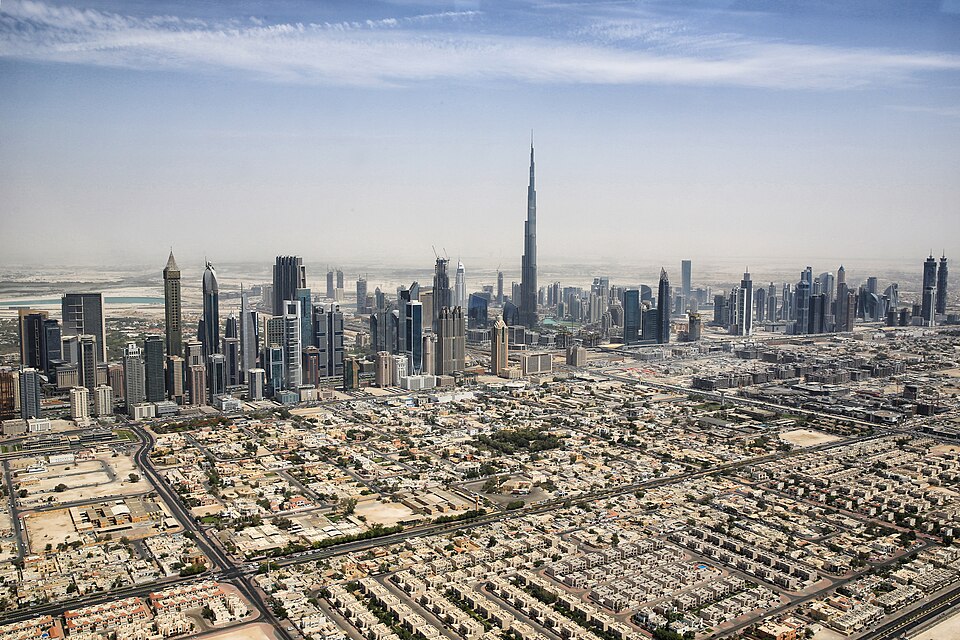
- Burj Khalifa — the world's tallest building; "At the Top" observation decks (levels 124/125/148). Book timed tickets ahead.
- Dubai Mall + Fountain show — one of the world's largest malls, an aquarium, and the free evening fountain show.
- Old Dubai — Al Fahidi & Dubai Creek — the historic wind-tower quarter; cross the creek on a traditional abra boat for a few fils.
- The souks — Gold & Spice (Deira) — traditional markets; haggling expected.
- Desert safari — 4×4 dune bashing, camel rides and dinner at a Bedouin-style camp under the stars.
- Palm Jumeirah & Atlantis — the palm-shaped island, the Aquaventure waterpark and The View at The Palm.
- Dubai Marina & JBR beach — waterfront promenade, dining, sunset.
- Museum of the Future — striking architecture and immersive exhibits.
- Day trip to Abu Dhabi — the Sheikh Zayed Grand Mosque (free; strict modest dress) and Louvre Abu Dhabi.
Getting around
- Metro — clean, cheap, air-conditioned and driverless; best for the Airport ↔ Downtown ↔ Marina corridor.
- Nol card — needed for the Metro/bus. For tourists the Silver Nol (~AED 25, valid 5 years) is the sensible pick.
- Taxis & Careem/Uber — Careem is the regional app and is often cheaper than street taxis; handy for the Palm, the beaches and late nights.
Connectivity — buy an eSIM before you fly
A Georgian SIM will roam expensively in the UAE, and activating a local eSIM on the ground is restricted for tourists. The simplest option is to buy an eSIM before departure and switch it on when you land. The UAE networks (e& and du) have strong 5G across the city and the desert. Plans start from around $4.
This is exactly the point where the concierge can offer you an eSIM matched to your route in one tap.
Practical & cultural tips
- Alcohol — legal for non-Muslims aged 21+ in licensed hotels and bars. Drinking or being drunk in public is not allowed, and the drink-driving limit is zero. If you're used to Georgia's relaxed wine culture, know the rules here are stricter and enforced.
- Dress — modest in public (malls, government buildings); swimwear is fine at the beach and pool. In mosques, cover arms and legs; women cover their hair.
- Ramadan — shifts ~10–11 days earlier each year; during it, avoid eating/drinking/smoking in public in daylight. Check the exact dates for your year of travel before booking.
- Currency — the Dirham (AED), pegged to the dollar (1 USD = 3.6725 AED). Cards are accepted everywhere; keep some cash for the souks and the abra.
- Safety — Dubai is very safe with low street crime, provided you respect local laws. Drug offences carry severe penalties.
What the entry rule asks for — and how to prepare
Dubai's visa-free entry itself requires a return ticket and valid insurance. So two things you'd want anyway are, here, literally part of the entry condition:
- Travel insurance — not an extra, but an entry requirement and your medical cover abroad.
- eSIM — since buying one locally is restricted, get it in advance.
- Airport transfer — especially if a cheaper flight lands you in Sharjah or Abu Dhabi, from where you still need to reach Dubai.
All three slot into your itinerary in one place inside Lumina's concierge — just say "Dubai, in November, 2 of us" and we build the rest.